Gravitational Waves: Ripples in Space-Time Explained

For most of history, astronomers studied the universe by observing light. Telescopes allowed scientists to examine stars, planets, and galaxies using visible light and other forms of radiation. However, there is another way to study the universe: by detecting tiny ripples in the structure of space itself. These ripples are known as gravitational waves.
Gravitational waves are disturbances in space-time, which is the combination of space and time into one connected structure. According to Albert Einstein’s theory of general relativity, massive objects bend space-time around them. When extremely massive objects move or collide, they can create waves that travel outward through the universe at the speed of light.
A useful comparison is to imagine dropping a stone into a still pond. The stone creates ripples that spread across the surface of the water. Gravitational waves behave somewhat similarly, except they travel through space-time rather than through water. As one passes, it very slightly stretches space in one direction and squeezes it in another.
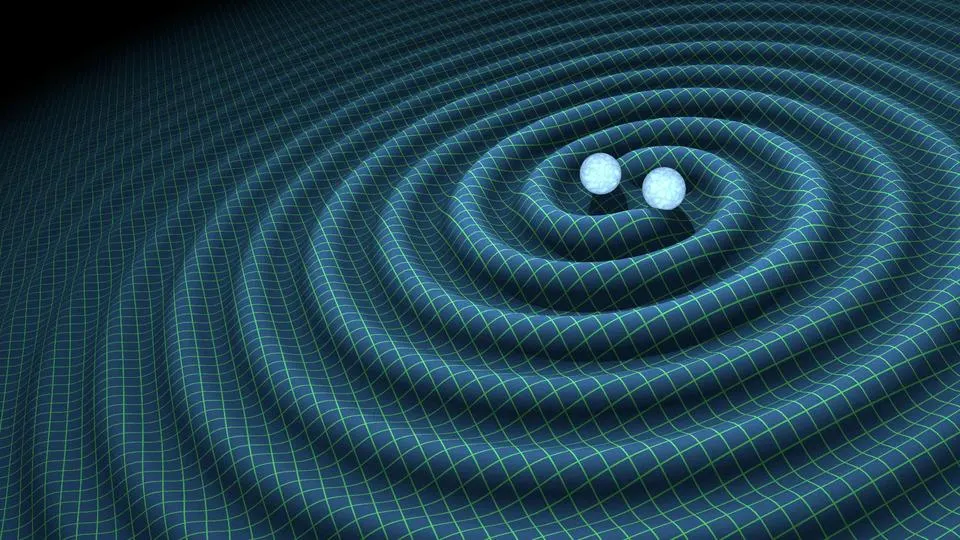
Almost any accelerating object can technically produce gravitational waves, but most are far too weak to detect. The strongest waves come from some of the universe’s most extreme events, such as two black holes colliding, two neutron stars merging, or possibly the explosion of a massive star. These events involve enormous amounts of mass moving at very high speeds.
Einstein predicted gravitational waves in 1916, but scientists did not detect them directly until 2015. The Laser Interferometer Gravitational-Wave Observatory, better known as LIGO, measured waves produced by two black holes that had merged around 1.3 billion light-years away. The discovery was announced in 2016 and confirmed an important prediction of general relativity.

Detecting gravitational waves is incredibly difficult because the changes they produce are extremely small by the time they reach Earth. LIGO uses laser beams traveling through long tunnels arranged in an L-shape. When a gravitational wave passes through, it changes the lengths of the tunnels by a tiny amount. Scientists compare the laser beams to identify this change and determine whether a wave has passed.
Gravitational waves are important because they give astronomers a completely new way to observe the universe. Some events, such as black hole mergers, may produce little or no visible light. Gravitational waves allow scientists to detect these hidden events and study objects that would otherwise be difficult to observe. When gravitational-wave information is combined with light detected by telescopes, scientists can develop a more complete picture of what happened.


Comments