Earth’s Orbit and the Milankovitch Cycles: The Next Ice Age
- Cyrine Badji

- May 29
- 2 min read
Ice ages do not happen randomly. Over very long periods of time, Earth’s climate shifts between colder glacial periods and warmer interglacial periods, and one major reason is a set of slow changes in Earth’s movement around the Sun called Milankovitch cycles. These cycles affect how sunlight is distributed across Earth, especially in the Northern Hemisphere, where large ice sheets can grow.
There are three main Milankovitch cycles. The first is eccentricity, which refers to changes in the shape of Earth’s orbit. Sometimes Earth’s orbit is more circular, and sometimes it is slightly more oval. The second is obliquity, or axial tilt, which changes the angle of Earth’s tilt over time. The third is precession, which is the slow wobble of Earth’s axis. Together, these cycles change how much solar energy different parts of Earth receive in different seasons.
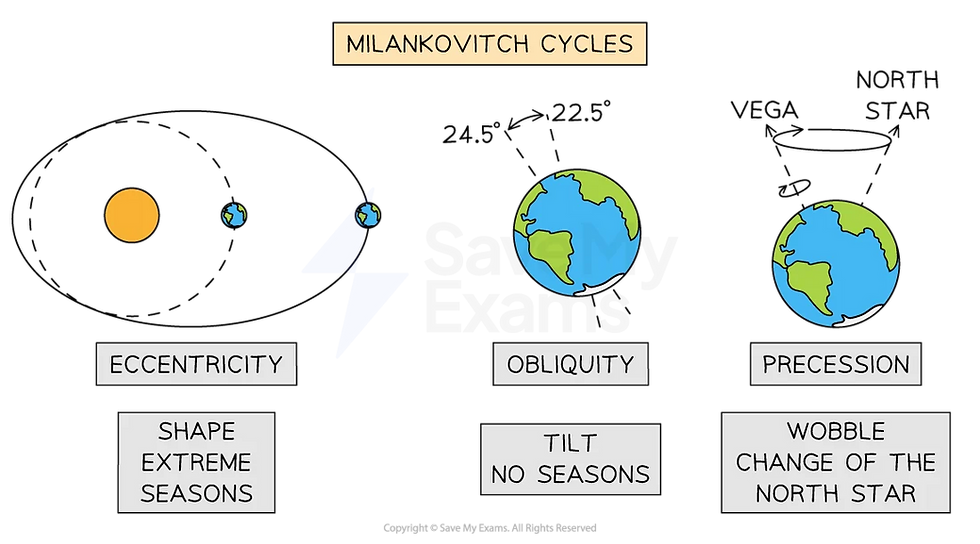
What matters especially for ice ages is not just the total amount of sunlight Earth gets, but how much summer sunlight reaches northern latitudes. If summers in the Northern Hemisphere become cool enough, winter snow does not fully melt. Over many years, more snow builds up, ice sheets expand, and their bright surfaces reflect more sunlight back into space. This creates a positive feedback effect that pushes the planet into a colder climate.
Milankovitch cycles are strongly linked to past ice age patterns, but they do not act alone. Ice sheets, oceans, and greenhouse gases also play major roles in shaping how strongly Earth responds to orbital changes. Scientists know that over the past million years, glacial-interglacial cycles have often followed a roughly 100,000-year rhythm, although the exact reasons for that pattern are still not completely understood.
So this leads us to the question: when is the next ice age supposed to happen? Under natural conditions, orbital cycles would still be influencing Earth’s long-term climate, but today human-caused warming is also playing a major role. NASA notes that Milankovitch cycles cannot explain current warming, and modern warming is happening much faster than the gradual climate changes linked to past ice age cycles. That means the next natural glacial period is not something expected anytime soon in the way people often imagine.
In the end, Milankovitch cycles show that Earth’s climate has always changed over time, but they also remind us that climate is shaped by many interacting factors. Studying these cycles helps scientists understand both the ancient ice ages of the past and why today’s rapid warming is a very different kind of climate story.



Comments