The Role of Artificial Intelligence in Space Exploration
- Cyrine Badji

- Feb 7, 2025
- 2 min read
As artificial intelligence (AI) increases in popularity in multiple sectors around the globe, AI is also playing an increasingly vital role in advancing space exploration. From navigating spacecraft to analyzing massive amounts of data, AI enables scientists to push the boundaries of what we know about the universe and streamline the complexities of space missions by automating some tedious tasks.
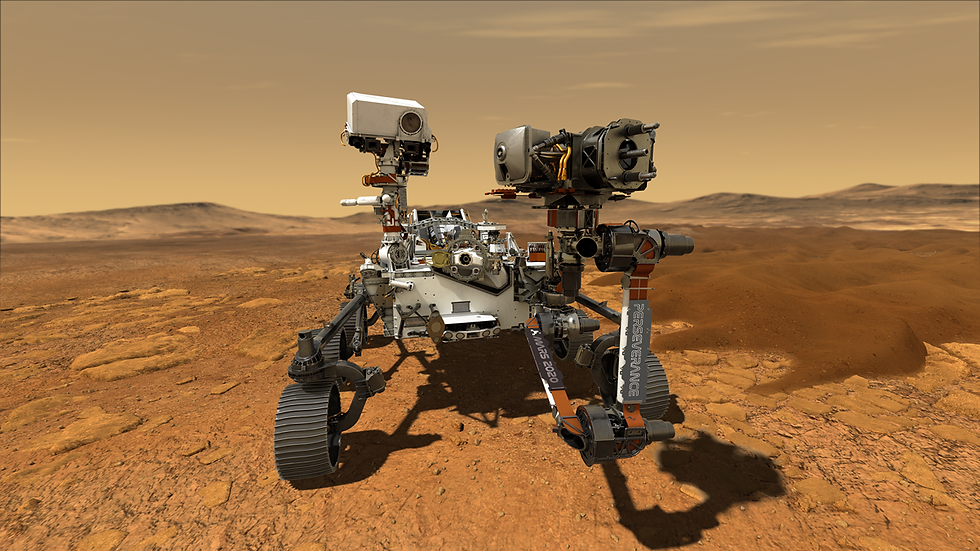
One of the key applications of AI in space exploration is autonomous navigation. Spacecraft traveling to distant planets or moons often operate millions of kilometers away from Earth, making real-time communication impossible due to the significant time lag. AI systems allow spacecraft to make independent decisions. For example, NASA’s Mars rovers, like Perseverance, use AI to avoid obstacles, determine optimal paths, and prioritize scientific tasks without waiting for instructions from Earth. This significantly increases the productivity of missions like these.
AI is also instrumental in data analysis. Modern space missions collect enormous amounts of data from high-resolution images of distant planets to measurements of cosmic phenomena. Processing and interpreting this data manually would be time-consuming and make the interpretations more prone to human error. AI algorithms can quickly sift through the information, identifying patterns, anomalies, or features of interest. For instance, AI has been used to detect exoplanets by analyzing data from telescopes like Kepler, identifying subtle dips in starlight caused by orbiting planets of stars.
Another area where AI proves to be indispensable is spacecraft system management. Space missions are highly complex and require constant monitoring of onboard systems to ensure the functionality of the spacecraft and the safety of both the spacecraft and the crew on board. AI can detect and respond to potential issues, such as a malfunctioning instrument or declining power levels, much faster than human operators. This capability reduces the risk of mission failures and extends the lifespan of spacecraft.
AI has a high potential in the field of space exploration. AI-driven robotic systems are also being developed for planetary exploration, such as collecting soil samples or constructing infrastructure on the Moon or Mars. However, challenges remain, including ensuring the reliability and security of AI systems in the harsh conditions of space. Researchers must also address ethical considerations, like how much autonomy AI should have in critical mission decisions. By enhancing efficiency and expanding our capabilities, AI is helping us reach farther into space, bringing us closer to answering some of the universe’s biggest questions.



Comments