Types of Solar Systems: How Planetary Systems Can Be Different
- Cyrine Badji

- May 8
- 3 min read
When people hear the phrase “solar system,” they often think of our own: the Sun at the center, rocky planets closer in, gas giants farther out, and smaller bodies like asteroids and comets spread throughout. For a long time, this was the only example scientists had. As a result, many people assumed that most planetary systems in the universe would probably look similar. However, the discovery of exoplanets has shown that solar systems can be arranged in many different ways around the universe.
A solar system, or more generally a planetary system, is a star and the objects that orbit it, such as planets, moons, asteroids, and comets. What makes these systems so interesting is that they can differ in size, structure, and composition. Some have small rocky planets close to their stars, while others contain giant planets orbiting surprisingly near the center. Some even have planets moving in unusual or highly stretched-out orbits.

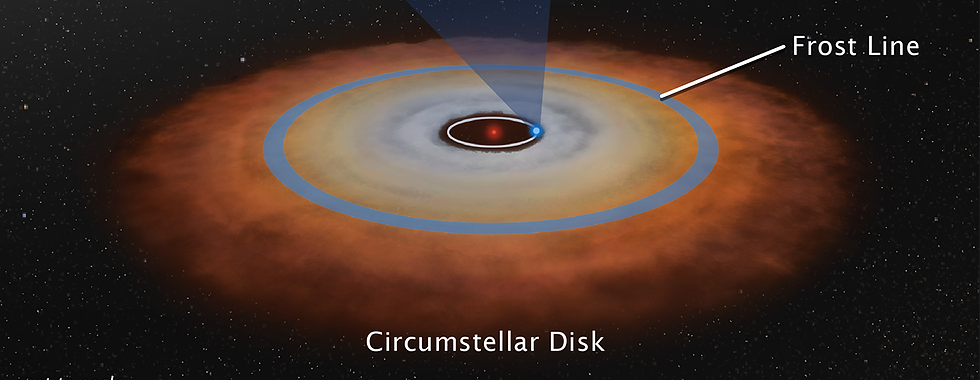
One major type of planetary system includes Hot Jupiters. These are large gas giant planets, similar in size to Jupiter, but they orbit extremely close to their stars. This was one of the biggest surprises in early exoplanet discoveries, because in our own solar system, giant planets are found much farther from the Sun. Hot Jupiters showed scientists that planets can move from where they originally formed, changing the overall structure of their systems. This is because gas giants primarily form far from their host star, specifically beyond a region known as the "snow line" or "frost line," where temperatures are low enough for solid ice to form. Scientists believe that Hot Jupiters did not form near their host star, but rather likely formed far out and migrated inward over time.
Other systems are known for having many super-Earths or mini-Neptunes. Super-Earths are planets larger than Earth but smaller than Neptune, while mini-Neptunes are slightly larger worlds with thick atmospheres. Interestingly, our solar system does not have any planets in these size categories, even though they seem to be common elsewhere. This shows that our own system may not be as typical as once thought.

Some planetary systems are also built around multiple stars instead of just one. In these cases, planets may orbit one star, or in some systems, they orbit both stars together. These are called circumbinary planets. There are 2 main types of binary solar systems. P-type systems are systems in which a planet orbits around both stars in a binary star system, rather than just one. On the other hand, T-type systems are systems in which a planet shares its orbit with another planet, staying near stable gravitational points called Trojan points.

Another important difference is the shape of planetary orbits. In our solar system, most planets orbit the Sun in paths that are fairly circular and lie roughly in the same plane. But in other systems, planets can have much more eccentric orbits, meaning their paths are more stretched out. Some systems may also be tightly packed, with several planets orbiting much closer to their stars than the planets in our solar system do.
These differences matter because they help scientists understand how planets form and evolve. They also affect whether a planet could have stable temperatures, liquid water, or conditions suitable for life. By comparing many kinds of planetary systems, astronomers can learn more about how common Earth-like worlds might be.
Studying different solar systems teaches us that the universe is far more varied than people once imagined. Our solar system is only one example among many. The more planets scientists discover, the clearer it becomes that there is no single “normal” way for a planetary system to look.



Comments