Types of Supernovae: How Stars End in Different Ways
- Cyrine Badji

- May 4
- 3 min read
A supernova is one of the most powerful events in the universe. It happens when a star reaches the end of its life and explodes, releasing an enormous amount of energy, light, and matter into space. For a short time, a single exploding star can shine more brightly than an entire galaxy. Even though all supernovae are dramatic stellar deaths, they do not all happen in the same way. In fact, astronomers classify them into different types depending on what causes the explosion.
The two main categories are Type I and Type II supernovae. The difference between them was first identified by studying their light. When astronomers analyze the light from a supernova, they look at its spectrum, which shows which elements are present. Type I supernovae do not show hydrogen in their spectra, while Type II supernovae do. This helps scientists understand what kind of star exploded and what process caused it.
Type II supernovae happen when a massive star runs out of fuel. During most of a star’s life, nuclear fusion in its core pushes outward while gravity pulls inward. These two forces stay balanced for millions of years. But once a very large star has fused heavier and heavier elements in its core, it eventually reaches iron. Iron does not produce energy through fusion in the same way, so the balance breaks down. Gravity suddenly wins, the core collapses, and the star explodes. This is called a core-collapse supernova. Type II supernovae are especially important because they scatter heavy elements into space, including elements that later become part of new stars, planets, and even living organisms.

Type I supernovae are a bit more varied, with the most well-known being Type Ia. This type usually involves a white dwarf, which is the small, dense leftover core of a star like our Sun. A white dwarf can explode if it is in a binary system with another star and gains too much material from its companion star. Once it reaches a critical limit, it can no longer remain stable, and a runaway explosion begins. Type Ia supernovae are especially useful to astronomers because they tend to reach a similar brightness, which means they can be used to measure distances across space. Therefore, even if one looks dimmer from Earth, that does not necessarily mean it was a weaker explosion, it just usually just means it is farther away.

On the other hand, there are also Type Ib and Type Ic supernovae. Like Type II, these are caused by the collapse of massive stars. However, before they explode, these stars lose their outer layers. In Type Ib supernovae, the star has already lost most of its hydrogen, often through powerful stellar winds or because a nearby companion star in a binary system has pulled that material away. Type Ic supernovae have lost both their hydrogen and helium layers before the explosion. Because these outer layers are missing, astronomers do not see the usual hydrogen or helium signatures in the supernova’s light, which helps them tell the different types apart.
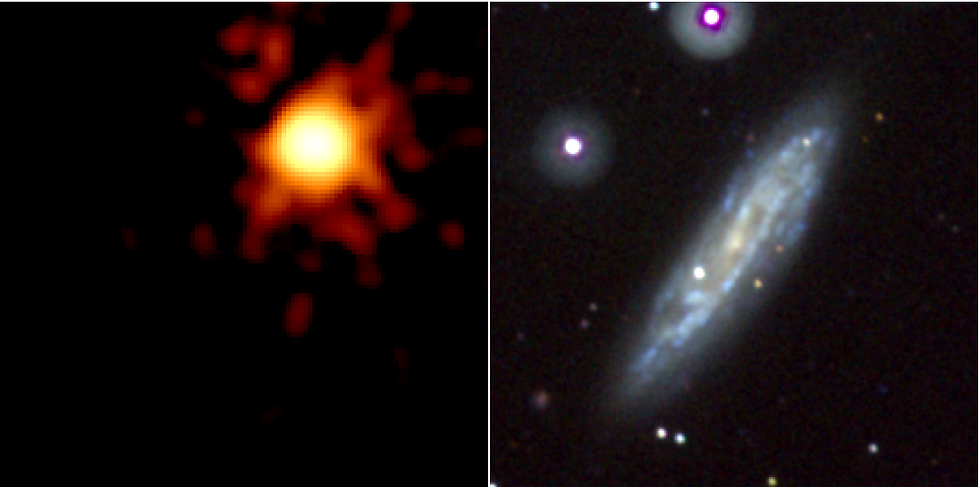
Studying supernovae helps scientists understand how stars evolve and how the universe changes over time. These explosions do not just mark the end of stars, but they also help create and spread the elements needed for future stars, planets, and life itself.



Comments